
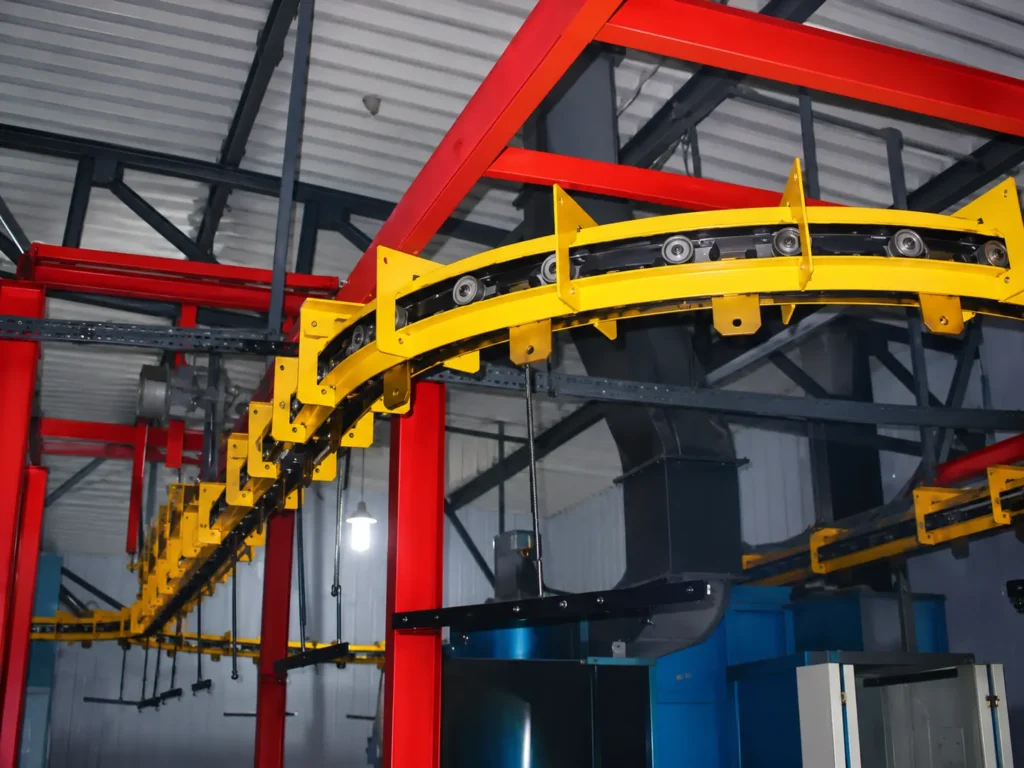
For today’s industries, moving the materials effectively plays a key role in ensuring production and eliminating manual labor. The Four Wheel Conveyor is one such conveyer that provides overhead conveyance systems for moving materials from one stage of the industry to another.
At Veltrix Conveyor System, we manufacture and supply industrial conveyor systems designed according to application requirements, load capacity, conveyor layout, and production needs.
A Four Wheel Conveyor is a conveyor that uses four wheel trolleys in order to transport items using an overhead conveyor track. This type of four wheel trolley enables steady transportation and aids in spreading out the load on the trolley assembly.
What Is a Four Wheel Conveyor?
This system can be employed for moving components, subassemblies, fabrications, garments, automotive components, and various industrial products between workstations.
The configuration of the conveyor will vary according to application and will incorporate different track configurations, trolley capacities, drive configurations, and suspension types.
How Does a Four Wheel Conveyor Work?
How Does a Four-Wheel Conveyor Operate?
The following parts make up the structure of a common Four-Wheel Conveyor:
Conveyor track
Four-wheel trolley
Conveyor chain
Drive unit
Sprockets
Tensioning device
Load carriers or attachments
Support frame
The drive unit runs the conveyor chain inside the conveyor track. The four-wheel trolley is attached to the chain and moves around the conveyor path with the material that needs to be transported.
The configuration of the conveyor may include straight lines, bends, elevations, and other routing options based on the factory space available.
Features of Four Wheel Conveyor
- Four-Wheel Trolley System
Four-Wheel Trolley System is effective in offering support to the suspended load and for controlled transportation of material.
- Continuous Transport of Materials
Materials are continuously transported through the conveyor from one place to another within the plant.
- Layout Flexibility
Layout flexibility can be offered by Four Wheel Conveyors in terms of its route design that can include straight lines, curves, and vertical sections.
- Applicability to Industries
This system is adaptable to many kinds of industries and applications.
- Decreased Manual Transport
Automation of the transport process allows decreasing the number of manual transports between workstations.
- Customizable Load Capacity
Trolleys and conveyors are customizable in terms of their carrying capacity based on the size and weight of the transported materials.
Applications of Four Wheel Conveyors
Four Wheel Conveyors are applied in the following industries among others:
Automotive Industry
Used in moving automotive subassemblies and components from one manufacturing process to another.
Fabrication Industry
Suitable for transportation of fabricated products and metal parts during fabrication and finishing process.
Painting Shop
The conveyor system can transport components for cleaning, pre-treatment, painting, drying, and other finishing operations.
Four wheel conveyor system can transport garments and workpieces from one production area to another if designed for the particular application.
Engineering Industries
Suitable for transportation of industrial parts and components continuously.
The conveyor system can link different workstations and production areas and thus help in establishing a material flow.
Advantages of Four Wheel Conveyor
With appropriate design, a four-wheel conveyor system can offer the following benefits:
Effective transportation of materials overhead
Effective utilization of floor space in factories
Continuous movement of materials
Less material handling
Flexible conveyor design
Movement of trolleys
Customizing the conveyor according to the need
Suitability for production process integration
Four Wheel Conveyor vs. Traditional Floor Conveyors
One of the main differences lies in the use of overhead space.
A floor conveyor system occupies space on the floor, while an overhead conveyor system carries materials above the floor. Thus, an overhead conveyor system leaves floor space free for machinery, operators, storage and other activities.
The choice of conveyor depends on parameters such as material weight, product size, manufacturing process, space available, speed and routing needs.
Factors to Consider Before Choosing a Four Wheel Conveyor
Before choosing a conveyor system, manufacturers should consider:
Load Capacity: Know how much load each trolley should carry.
Material Size: The material size and shape determine which trolley and carrier to use.
Conveyor Length: Conveyors’ total length determines drive requirements.
Conveyor Route: Curves, elevations, loading positions, and unloading positions must be taken into account.
Operating Speed: Required production volume determines the speed of conveyor.
Working Environment: Temperature, dust, chemicals, moisture, and paint shop conditions may affect equipment selection.
Carrier Design: The carrier or attachment must secure the material being conveyed.
Maintenance of Four Wheel Conveyor
Maintenance plays a major role in keeping the conveyor working smoothly.
These important maintenance works involve:
- Inspecting trolley wheels
- Inspection of the conveyor chain
- Lubrication of moving parts if needed
- Inspecting sprockets
- Inspecting drive unit
- Inspecting joints and support
- Inspecting tensioning mechanism
- Inspection of load carrier and attachments
- Inspecting for unusual noise or vibration
Maintenance schedule has to be done accordingly to the operating condition and conveyor application.
Why Choose Veltrix Conveyor System?
Veltrix Conveyor System provides conveyors for material handling and manufacturing applications.
Our approach includes design of conveyor system as per the customer requirement such as:
- Conveyor layout
- Conveyor load capacity
- Conveyor length
- Conveyor operating speed
- Nature of material
- Available factory floor space
- Manufacturing process
- Level of automation required
Conveyors are designed for material handling in industries and custom-designed conveyors are available as per the project requirements.
FAQs about Four Wheel Conveyor
What is a Four Wheel Conveyor?
It is an overhead conveyor system using four-wheel trolleys running on conveyor tracks.
Where can I use Four Wheel Conveyors?
They are used in automotive industry, fabrication shops, engineering workshops, paint-shops, garment industry and others industrial material handling applications.
What is the benefit of four wheel trolleys?
It is a stable trolley support and distribution of load during conveyor operation.
Is it possible to customize a Four Wheel Conveyor?
Yes. It is possible to specify conveyor length and layout, trolleys configuration, load capacity, carriers, drive type and other specifications depending on your needs.
How should I choose a Four Wheel Conveyor?
Load weight, material dimensions, conveyor length, needed speed, route and others are taken into account while choosing a conveyor.
Get a Four Wheel Conveyor Designed for Your Industrial Needs
Conveyor configuration selection plays an essential role in successful and reliable materials transportation and manufacturing processes. Four Wheel Conveyor is a useful device to move materials at different stages of manufacturing process.
In case you need any of the above-mentioned services of a conveyor system, we at Veltrix Conveyor System can assist you in developing a conveyor system as per your application specifications.
For the Four Wheel Conveyor systems and customized quotations, contact us at Veltrix Conveyor System.

